








Choose a software migration partner that maps dependencies before changing code, has moved your kind of stack and data before, and validates data against the source at each step. Saigon Technology works this way, with senior engineers leading discovery, data validation, and cutover.
 Who does the migration work, and what does it cost?
Senior engineers lead the work and use AI-assisted code analysis to map an undocumented system before migration starts, and architects review each such change. Rates run USD $22-$46/hr, senior-led, and the cost case is fewer rebuilt modules after cutover.
How is our data protected while it moves?
Migration work runs inside Saigon Technology's ISO 27001 and ISO 9001 systems, both certified by BSI (UK). NDAs are signed before requirements are shared, and HIPAA and PCI-DSS requirements are met where the workload needs them, which matters when patient or payment records change platforms.
Will the same team support the system after cutover?
Yes, the team that moves the system stays on, so the people who know the data mapping stay with it. Saigon Technology ranks #10 (Medium) in Southeast Asia Best Workplaces™ in Technology 2026, and on Turn It Blue Ads one team has closed 130+ support items since 2022.
Will you tell us when a full migration is the wrong call?
A Senior Solution Architect such as Quy Truong reviews the system on day one, before any estimate, and recommends the lightest move that fixes the problem, including rehosting or leaving a stable module in place.
How do we follow progress during the migration?
One named Project Manager works with you directly, and you get Jira and code repository access to track each migrated module. US teams get 10-12 hours of daily overlap across East and West Coast business hours.
What track record stands behind the work?
Saigon Technology brings 14+ years, 400+ developers, 850+ projects, 350+ clients, and a 4.8★ Clutch rating, with work in healthcare, fintech, and logistics. Where a client has not cleared a figure, the case studies above describe the work instead of inventing a metric.
Can we test the team before committing?
Start with a two-week risk-free trial to check the team on your system before a longer commitment. Then continue on a fixed-price, dedicated team, or staff augmentation model, chosen by how settled your migration scope is.







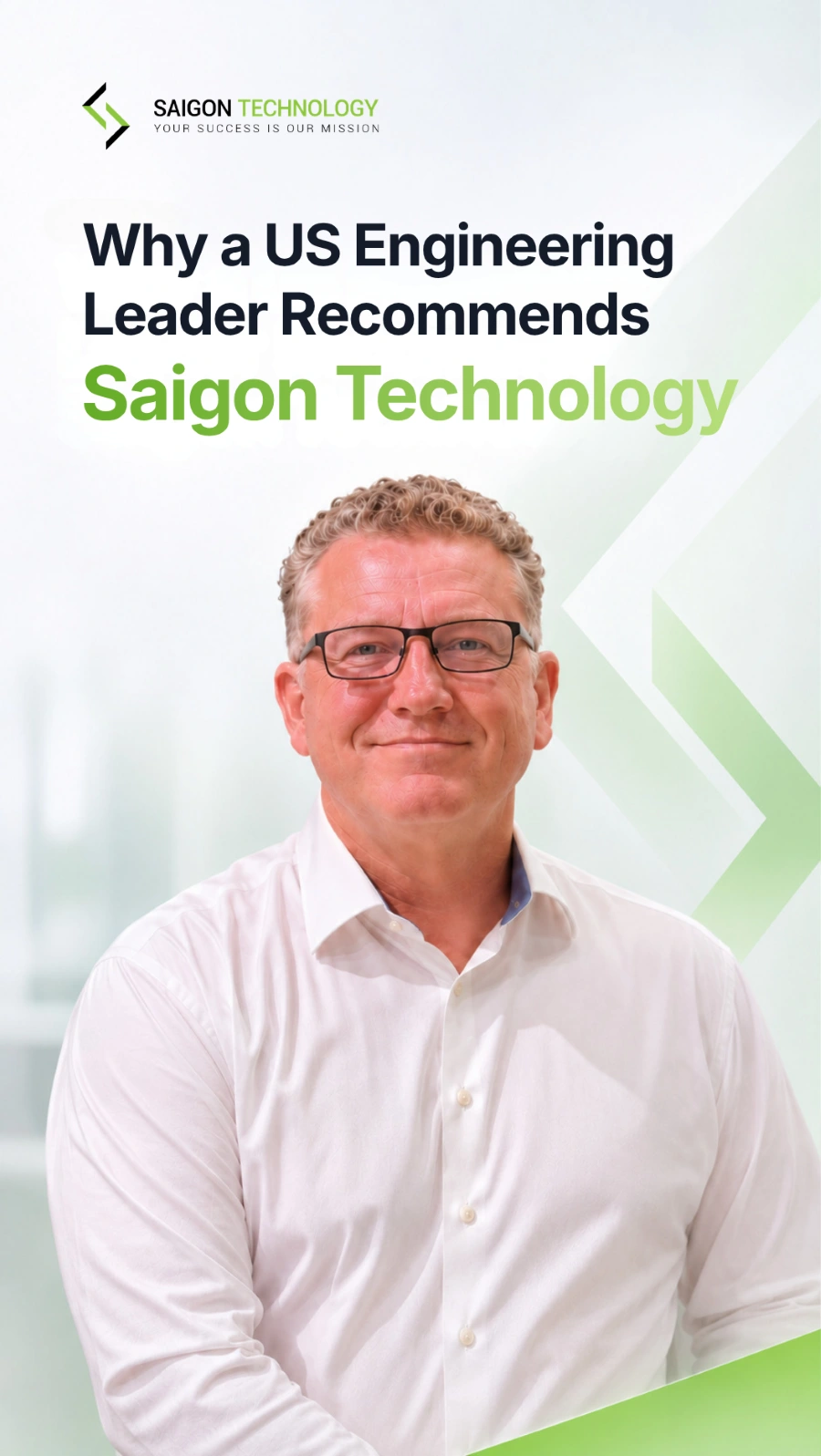

As the Owner and Director of ISMS Global, Australia, I understand perfectly how challenging it is to find a support team of skilled and professional developers to help grow a system. A few years ago, I found Saigon Technology Software (STS), led by Mr. Thanh Pham (CEO), and I have never looked back. STS has single-handedly taken ISMS camp management software from a concept on a napkin to an international product used by major companies around the world. If you are looking for a trusted partner to help you, then you should be talking to Thanh Pham.

I had the opportunity to work with Thanh (Bruce) Pham and his team. What a nice experience, though! It could be said that I was impressed by his professionalism and his team's enthusiasm. They always asked me to check the right demand and to make sure whether each work point was the best option or not. It was my honor to work with such a great team of software development. Hope to meet them soon in the upcoming time!

No doubt that Saigon Technology is one of the most reliable software development partners of DMI Global. Highly recommend them!

Not every system needs a full rewrite. The right migration scenario depends on your cost, risk, and timeline, so we start by matching your system to one of the proven migration approaches, then recommend the one that fits your industry's specific requirements, and tell you plainly when the simpler option is the smarter one.
Move the system as-is to modern infrastructure. Fastest, lowest risk; limited change to the code.
Move with targeted improvements (e.g., a new database engine) and minimal code change.
Restructure the codebase and apply clean architecture to fix technical debt while keeping behavior.
Redesign toward microservices for scalability and independent deployment.
Rewrite the application on a modern stack when the legacy base can't carry the business forward.
Retire and swap for a new solution when that delivers more value than migrating.
Done right, migration pays for itself. Our clients see:
 Lower maintenance costs
Retire outdated components and stop paying to keep fragile systems alive.
Stronger security & compliance
Close the gaps that legacy platforms leave open.
Enhanced scalability
Architectures that grow with demand instead of buckling under it.
Better performance
Faster queries, cleaner data flows, and fewer failures.
Unlocked integrations & AI-readiness
Modern APIs that connect to the tools your business needs next.
Reduced technical debt
A clean architecture foundation that speeds up every future release.

General project planning, dependency mapping, and code analysis to understand the real state of the system and the possible risks.

Approach selection (the 6 R's), ROI and risk estimates, and a predictable plan with timelines and team composition.

Structured data migrations with mapping, validation, and reconciliation.

Refactoring and seamless migration of not-supported third-party components, plus correction of run-time errors and integration with your existing systems.

Manual and automated testing across environments to hold quality under load.
A zero-downtime, staged cutover that keeps services available.
Documentation, training, and ongoing support with a managed team or time and materials model to fit your needs.
























Software migration services move an application, its data, and its code from an outdated platform to a modern one, without losing functionality. They cover legacy code migration, database and data migration, replatforming, architecture migration, and cloud migration.
A software migration company audits your legacy system, recommends a migration approach, then migrates code, data, and infrastructure with testing and validation. Saigon Technology also handles integration, phased cutover, and post-launch support.
Cost depends on system size, migration approach, and complexity. Saigon Technology works at published rates of $22-$46/hr and provides a fixed estimate after a short code-analysis and scoping phase, so you get a predictable plan before work begins.
Timelines range from a few weeks for a rehost to several months for a full rebuild. After discovery and code analysis, we give you a roadmap with main stages and clear milestones.
Outsourcing gives you senior migration specialists and a proven framework without hiring and retaining a niche team. Saigon Technology offers a two-week risk-free trial so you can validate the fit before committing.
Core technologies (tailored to your migration):
Standards & compliance: ISO 9001 (Quality) and ISO 27001 (Information Security); HIPAA / HL7 for healthcare; PCI-DSS for fintech; GDPR and PDPA for data protection. For regulated systems such as a payment system, payroll & tax management software, or an ERP system, we keep data compliant at every stage of the migration.
We use a phased cutover and structured data migrations with mapping, validation, and reconciliation against the source. Legacy systems stay online, connected via APIs, until the new platform is verified.
Compliance is built into every stage: encryption, role-based access, audit trails, and secure engineering aligned with ISO 27001, HIPAA/HL7, PCI-DSS, GDPR, and PDPA, matched to your industry's specific requirements.
Book a free 30-minute call





 May 20, 2025